Mad Max: Fury Road
Mad Max
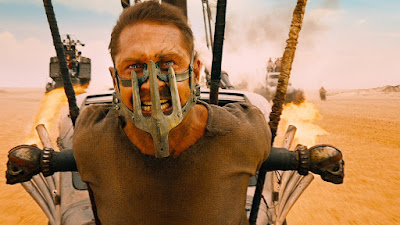 |
| Warner Bros. |
Walking out of the theater after watching Mad Max: Fury Road, my brother, commenting on what he had just witnessed, says “that was probably the weirdest thing I’ve ever seen.” While I can’t say it’s the weirdest thing I’ve ever seen, it certainly one of the more bizarrely manic, action packed blockbusters I have seen. With Fury Road, George Miller returns the to the Mad Max world he created decades ago. This time around though, Tom Hardy steps in as the title character with Charlize Thereon by his side but it is Miller that garnishes most of the attention as he destroys any "out-of-touch" thoughts or comments with this latest installment. Mad Max: Fury Road is as bizarre and loony as it is billed and equally matched with careful construction and engaging ideas.
Using basically the same back story as the Mel Gibson filled role from the past, Fury Road’s Max (Tom Hardy) was once an officer of the law in Australia but now struggles to stay sane in an apocalyptic civilization that has gone completely mad. As a result of this type of atmosphere, as heard in voice over or seen in frequent flashbacks, Max is haunted by the death of his daughter. In the film’s opening scene, Max fails to escape the madness as he is captured by what are referred to as War Boys, extremely pale skinned, unhealthy soldiers for cult leader Immortan Joe (Hugh Keays-Byrne).
Meanwhile, as the War Boys are returning to the Immortan Joe ruled compound-like fortress with Max, Imperator Furiosa (Charlize Theron) is departing in War Rig, a large extremely durable vehicle used to transport gasoline. When Furiosa takes a left, straying off the usual path, the war boys along with neighboring communities must stop her from going any further. Used as a blood donor or "blood bag" for ill War Boy Nux (Nicholas Hoult), Max, strapped on to the front of a fast moving vehicle, must also go along.
While Max is forced to get into the madness for the majority of the film when violently confronted, he is otherwise rather reserved, saying few words as he attempts to battle the madding thoughts within. When this type of Max is on screen, the audience is reminded that the right guy is filling the role. Sure, Tom Hardy can deliver a line in the most charismatic of ways (Inception or Bronson) but here he proves, if he hadn’t already, that he is just as entertaining when taking a non-verbal route.
The insanity that takes over the screen, comes in the form of the War Boys and everything else that share the same motives. The War Boys, more creature-like than human, solidly represent the product of a desolate and mentally taxing world that pushes you to be in the most madding and manic of states in order to survive as every word they utter, though hard to understand at times, is nobly stated and always seems aimed at the task at hand.
In a film like Fury Road though, when the spectacle and strangeness are blended together to create something entirely off the wall bonkers, the bizarreness of the War Boys takes a back seat at times. Of course Immortan Joe is a sight to be seen but thoughts of "what exactly am I watching?" will flood the mind when a man chained to a large vehicle plays a fire-spitting guitar along with contraptions that give stunt a new meaning quickly grab your attention.
But even through all this, Miller is still able to add depth and real weight to it all. Miller’s chaotic approach represents a lot more than just a well done, action packed summer flick. The constant motion, explosion heavy, urgent and desperate atmosphere present in Fury Road’s action sequences may be fascinating to watch but it is their collective meanings and themes that make them all the better. Survival and how these sequences matches the fight that comes with it is clear but Millers story digs a bit deeper to reach a more personal level.
This comes in the form of the five wives and Furiosa. With Immortan Joe’s cult, there are classification groups that individuals are put in. Max is a part of the blood donor group but there is also a breeding group that consist of the five wives of Immortan Joe, headlined by a pregnant Angharad (Rosie Huntington-Whiteley). These five women along with Furiosa represent the pursuit for a better life for not just them, but their children as Furiosa attempts to take them to a better place, her childhood home. What they must go through to get there, fighting off the forces of Immortan Joes’s, symbolizes how brutally intense and difficult this pursuit can be with imagery accompanying it that is absolutely phenomenal at times.
What Miller’s approach does more than anything is make it clear that escaping madness is one dangerous ride. Whether it be through Max or others, redemption and starting anew in a completely hopeless world is no easy task. Miller just happens to make this statement while also creating a visually striking experience at the cinemas. Even though it may run just a bit long, dragging in the middle at times, Mad Max: Fury Road is one of the few action films in recent memory that matches, at an extreme level I might add, its genre with its message, only aiding each other in the process.
Grade: B
Review written by Brad Shawgo. Visit his blog, ShawGoesToTheMovies, for more great film reviews and movie posts.
Published on 6/8/2015 9:07:40 PM
Ex Machina
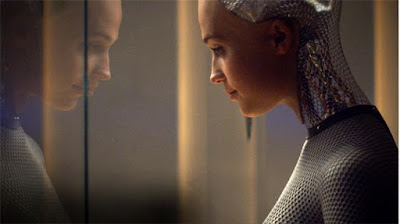 |
| Universal Pictures |
Through-out its running time, Ex Machina is a film that never allows its viewer to just go through the motions, forcing one to feel something at all times. If I wasn’t terrified, I was laughing and if I wasn’t laughing, I was squirming in my seat. As one particular feeling changed from one moment to the next, a mesmerizing sensation accompanied all of them. Because of this, with Ex Machina, it is clear that writer and director Alex Garland has taken full advantage of the science fiction drama to create a piece of work that is wonderfully crafted and extremely thought provoking.
At the base of the story Garland tells is artificial intelligence in the form of Ava (Alicia Vikander), an A.I. created in a remote research lab by Nathan Bateman (Oscar Isaac), C.E.O. of Bluebook, the world’s largest search engine. Caleb Smith (Domhnall Gleeson), a computer programmer for Bluebook, has been selected by Nathan to perform the Turing test, a test to determine if a machine intelligently has human capabilities.
To say anything more about Ex Machina's plot would give too much away and this is certainly a film that’s eerie but welcomed tone and atmosphere is aided by plot reveals and turns. With that said though, by no means is this a film that relies on the details or twist of its plot to be successful and while Garland’s technical approach only helps, it is the ideas within this story that constantly keep you engaged.
Though his subject may be artificial intelligence, Garland aims directly at the human condition, only using A.I. as a vehicle to explore multiple themes regarding thought processing and emotions of a human and how it plays into instinct, reaction and even society. One of the more explicitly presented of these themes comes in the form of Nathan explaining to Caleb why A.I. needs a gender as he comes right out and addresses how gender plays a role in human characteristics. As a human, we are either male or female and we define ourselves as a male or as a female. Our gender gives us boundaries and a natural definition of who we are, therefore our sexuality becomes a major part of how we think.
Another theme explored is how we tend to treat humans as objects rather than a living, breathing species just like us. Highlighting a societal trend, Ex Machina more specifically looks at how woman are treated this way. This trend is represented by Nathan’s assistant Kyoko (Sonoya Mizuno in an excellent, nearly non-verbal performance) and how he couldn’t treat her any less human. The fact that she barely says a word makes the comparison to an object even more obvious.
The way that Nathan treats Kyoko along with his overall arrogance plays into the ‘playing God’ concept that is often weaved into A.I. storylines. While directly looking at the consequences when attempting to play God, Ex Machina takes an approach similar to a Greek tragedy. Nathan, with all his power and knowledge, becomes too comfortable in the position he is in and blind to how much stronger his creation is than him. Garland quickly pens him as the villain here and someone that must be stopped. His downfall is progressively represented in his constant drinking. He becomes intoxicated often which causes him to foolishly let his guard down.
At its core though, Ex Machina is a tale of survival. When it comes to humans and machines or in this case A.I., desperation is something that both experience when survival is in question. The difference though, when doing whatever it takes to survive, is emotion. Machines don't have them but humans are basically made of them which, as Ex Machina suggest, as Caleb and Ava are put in survival mode due to the power of Nathan, only get in the way. This idea would appear to only regard surviving against machines but it applies to any survival situation. Trust, loyalty and companionship are a few of the things one can’t help but feel when his or her life is on the line. These are also things that can help or harm a human in a survival situation.
Science Fiction has the capability of exploring real ideas and concepts in the most haunting but fascinating ways and with Ex Machina, Garland fully realizes this. Garland’s ability to reach the audience with a crisp but unforgettably alarming approach that explores ideas that directly relate to us as they come from the very foundations of our being. Whether it can be tied into technology or societal occurrences, Garland’s Ex Machina does so as humanly as possible, making it not just a work of science fiction but a thought provoking piece that will have no trouble relating for a very long time.
Grade: A-
Review written by Brad Shawgo. Visit his blog, ShawGoesToTheMovies, for more great film reviews and movie posts.
Published on 6/2/2015 10:43:27 PM
Avengers: Age of Ultron
 |
| Walt Disney Pictures |
One thing that cannot be argued when it comes to Avengers: Age of Ultron is the tremendous amount of pressure it has riding on it. It’s the All Star Game-like event of Marvels cinematic universe, a format that has taken over cinema, not just financially but has also influenced studios to take the same approach. Because of all this, it shouldn’t come as a surprise that it Age of Ultron comes off as a movie under a lot pressure.
Needless to say, there are a lot people to please and a lot of expectations, so director Joss Whedon goes for broke. Of course the action is extended but a story is attempted that has the ability to satisfy the usual fans but also those that may not be so fond of what Marvel has been doing. While Whedon’s attempt is valid, the result is that the film as a whole is just too big to sustain any type of focus.
Age of Ultron waste no time getting into the action as the Avengers are found in Sokovia attempting to secure a familiar item to the Marvel Cinematic Universe (MCU), the scepter that Loki has used to wreak havoc in the past. Featuring very similar big scale action from previous entries, this rather long sequence has all the previous players but it is also here that a couple of new faces make their way to the franchise in the form of Wanda (Elizabeth Olsen) and Pietro (Aaron Taylor-Johnson) Maximoff, twins that have been used to Hyrdra’s advantage, against the Avengers in this intro, because of their special abilities.
Of course though, the Avengers come up victories, safely securing (other than at the expense of several Hydra faithful’s) the scepter. It is when they arrive back to the states that the team really runs into trouble and have only their selves to blame. Attempting to create artificial intelligence for some time, Tony Stark (Robert Downey Jr.) and Bruce Banner (Mark Ruffalo) discover that the technology that the scepter possess is likely the missing piece to the puzzle. Things don’t go as planned though when this A.I., known as Ultron (voiced by James Spader), not only becomes immensely powerful but quickly turns against them.
The reason Ultron is immediately a villain so to speak, is where Whedon attempts to add some weight to the story. Following an entertaining, Oceans 11-like moment that features the Avengers celebrating after their triumph in Sokovia is when the team first meets Ultron who is quick to point out their arrogance. Other than brief references in the Iron Man series and Thor, this is really the first time that this group of heroes have been directly accused of arrogance and this thought of being too big to fail. Ultron, a product of A.I. created by members of the Avengers, may even be proof that he is right, relating to the idea that you can’t expect to play God and not be greeted with consequences.
Going along with this concept and Ultron’s questioning of what the Avengers stand for is the idea of change and how it relates to making the world a better place. What are we willing to change or sacrifice to make things better? Ultron touches on this when posing a similar question that accuses the Avengers of not being willing to change or sacrifice to change the world. This motivation of Ultron’s is also connected to the idea of humans not evolving and being a race that is only harming itself, reaching a Transformer-ish feel. These interesting beliefs of Ultron become somewhat under developed though as it doesn’t appear to emotionally rattle the Avengers all that much.
Another storyline that hasn’t been explored before in the MCU is a romance between to members of the Avengers. In the Age of Ultron it is revealed that Bruce Banner, or the Hulk, and Natasha Romanoff (Scarlett Johansson) have been involved in a romantic relationship but due to Banners condition, something he is struggling to control in this entry, a committed relationship isn’t realistic. Banner doesn’t let Romanoff in, so to speak, because he sees himself as the Hulk not as a man who becomes the Hulk.
The dialogue between the two never reaches the emotional level it could and therefore the chemistry between Ruffalo and Johansson leaves some to be desired but this doesn’t pertain to how satisfying it is to see Romanoff turn the Hulk back to Bruce with a simple lullaby. We all have that person(s) in are life that just fits us, is capable of bring us back down to earth and reminds us that we are human for the good and the bad which is what this lullaby fittingly represents as it pertains to the relationship between Banner and Romanoff.
All of these storylines and interesting ideas, while underplayed slightly, are also hindered by the heavy, plentiful action sequences. Age of Ultron is never able to establish any kind of flow or identity when it comes to plot or the themes within as it constantly switches back to long sequences of lack luster, sometimes pointless action that’s main concern is including everyone and being extremely large in scale. And when I say everyone I mean everyone. For this, credit is due to Whedon for achieving this balancing act of including all the different pieces but even so, because of everything happening it is still easy to quickly lose focus when witnessing these moments and the film in general.
So when the credits begin to role and the mid-credit scene happens and the credits start up again and as you finally walk out of the theater, feelings of admiration for the ambition involved are unfortunately accompanied by pity. While Age of Ultron is as big as it was billed, it’s hard not to feel a little bad for the people involved (Whedon mainly) as it doesn’t feel like a movie that was ever given a chance to have its own personality.
What made Marvels last two entries, Captain America: The Winter Soldier and Guardians of the Galaxy, not just good in their own realm but entertaining cinema in general is that they were able to establish some kind heartbeat, some kind of rhythm that made them hard not to like. It’s hard to believe that this Avengers franchise, with its massive foundation and roots, is able to stray too far away from being much more than a movie that is as much a brand. And while the interesting ideas are in small doses, Age of Ultron’s restrictions are the main take away.
Grade: C
Review written by Brad Shawgo. Visit his blog, ShawGoesToTheMovies, for more great film reviews and movie posts.
Published on 6/2/2015 10:42:41 PM
The Age of Adaline
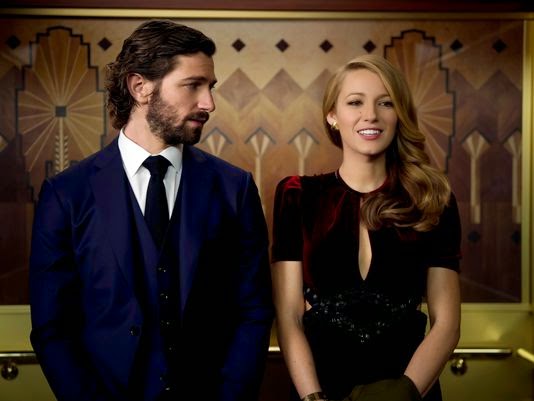 |
| Lionsgate |
How would you approach life if you never grew older? How would it affect the way you form or participate in relationships? Of course, it’s a scenario of pure fantasy but the question that arise from the implications it would have concerning the human spirit are interesting to think about. The Age of Adaline explores this scenario as its title character is faced with the reality of never aging.
With a rather History Channel-like voice over explanation, we learn that Adaline Bowman (Blake Lively) miraculously acquired the condition of never aging past the age of 29 after being struck by lightning immediately after driving off the road resulted in an automobile accident. Because of this super natural condition, Adaline must constantly flee from identity to identity, city to city in order to keep anyone from ever finding out who she really is.
Problems with this way of life arise though when, at the insisting of her daughter Flemming (Ellen Burstyn, becoming the go to choose when casting a daughter that is older than a parent), begins a relationship with Ellis (Michiel Huisman) whose father James happens to be a past romance of hers. While this premise along with the romantic tie in is charming, The Age of Adaline never goes as deep as it could given its thought provoking dilemma.
The Age of Adaline posses a level of sophistication that is rather satisfying in large part due to its pacing and title character. While were not talking about an extremely smart script, it does, ii its first act anyway, seem to know how to present the subject matter in an eloquent way that gives it a highbrow feel. It lets things play out a bit without a whole lot of talk, almost as if the audience is being slowly seduced into the story. This all helps in properly introducing the character of Adaline.
The romantic storyline here can be very charming at times but not near as charming as Adaline herself. Just moments after The Age of Adaline begins, it becomes clear that Adaline is knowledgeable and not afraid to let it be known. The audience sees this knowledge throughout with her witty, almost passive aggressive like way of sharing facts or just wisdom that she has gained over her many years on earth.
The characteristics of Adaline wouldn’t be as satisfying if not for Blake Lively in the role. Lively, very charming herself, seems to be a perfect choice here as she takes on the role with the right level of confidence and whit needed. It is her delivery that not just carries a large portion of the film but matches or even setting the films pace.
As the story starts to unravel, when its romantic plot reaches its climax, the enjoyment in the film up to this point and the character fades away. With its premise and plot, The Age of Adaline promises an epic sort of romance. And while the romance between Adaline and Ellis along with flashbacks between her and James can be rather delightful at times, it never reaches the grand level that is expected as things move too fast for its own good. While the mistake of turning things into a love triangle is avoided, the last 30 minutes move quickly from one unoriginal plot point to another.
Where The Age of Adaline is at it’s most disappointing though is how it never really goes too deep in exploring the psychological affects of never aging. It appears to be more concerned with the physical affects of it, such as always having to flee from a relationship and while this works when it comes to the coming of age storyline, the detrimental affects Adaline’s condition can have on her are given little detail. It would certainly be a tragic condition, which needs to be felt and made clear for the film to be fully effective.
Grade: C
Review written by Brad Shawgo. Visit his blog, ShawGoesToTheMovies, for more great film reviews and movie posts.
Published on 6/2/2015 10:41:56 PM
Fast and Furious 7
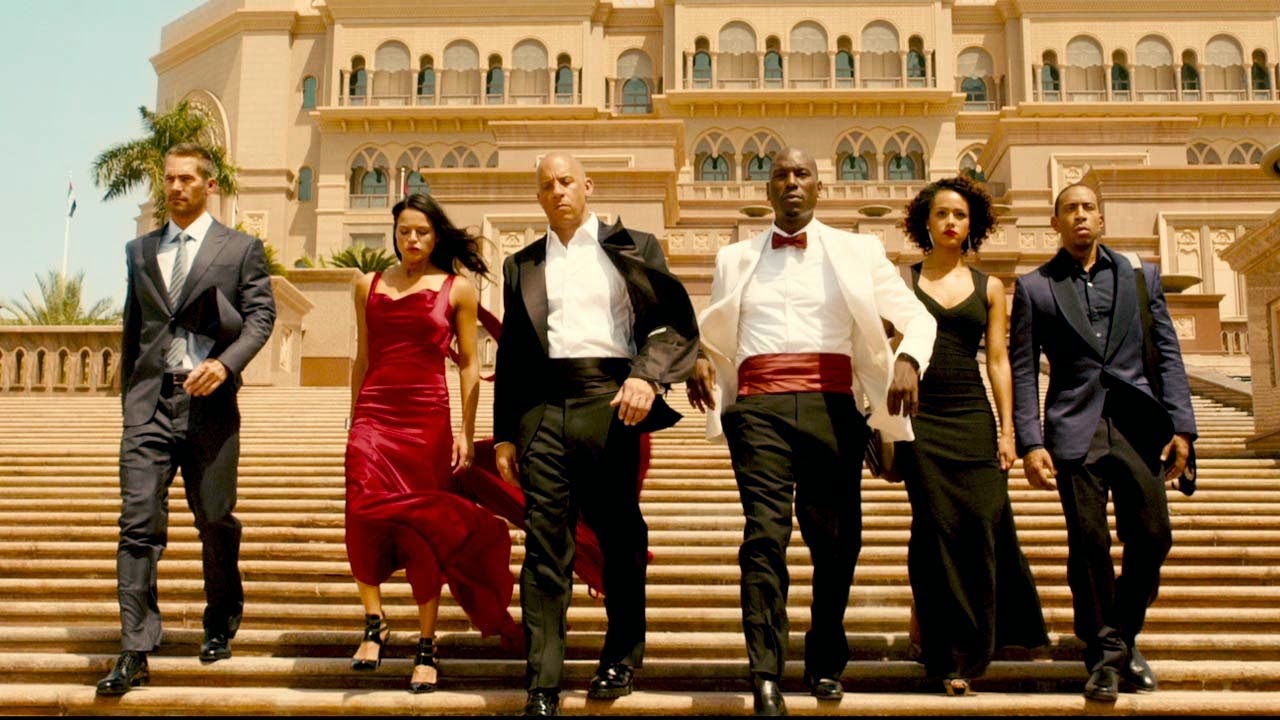 |
| Universal Pictures |
It quickly becomes clear that Furious 7 is going to play more like a highlight reel rather than another story in the franchise. It doesn’t waste any time with a plot or even a whole lot of talk, almost as if director James Wan and screenwriter Chris Morgan realized that none of this is the reason that the franchise has only became stronger with each entry. So where does its success come from. What the Fast and Furious franchise does best is explosive, large-scale action sequences. Furious 7 highlights this strength by amping the action up way beyond any level it has reached before, to the point that it completely takes over.
Furious 7 picks up where the Fast and Furious 6 credits scene left off with Owen Shaw’s brother Deckard Shaw (Jason Statham) going after Dom, Brian and the rest of the crew that was responsible for the death of his brother. It is made very clear early and often that Deckard is even more ruthless than his brother. He successfully kills Han (Sung Kang) in Tokyo (the credit scene in Fast & Furious 6 but depicted here as well) but fails to kill Brian and his family after blowing up their house and only manages to put Hobbs (Dwayne Johnson) in the hospital after he somehow survives a massive jump from a building exploding at the hands of Deckard.
This prompts the crew to go into all out protection mode while attempting to get to Deckard before he gets to them. This catches the attention of Mr. Nobody (Kurt Russell), an off the record type of government agent that is after a dangerous computer program called ‘Gods Eye’ before it gets into the hands of a terrorist by the name of Jakande (Djimon Hounsou). Seeing an opportunity to help each other get what they want, Mr. Nobody offers to help get Shaw for Dom if Dom and the others will get him ‘Gods Eye’. After agreeing, the crew, keeping up with the world traveling theme the previous films have done, find themselves in Dubai but end up back in Los Angeles for a massive showdown with Deckard.
And what a showdown it is. You have the Rock, after surviving a ridicules fall, flexing out of a cast to break out of the hospital in order to help the crew by firing off countless rounds from a gun even bigger than him. While this is happening, Dom rolls his car a thousand times and just when you may think this is the one that did him in he pulls through like there is nothing to it. This all seems ordinary though given what takes place leading up to this Expendables-esque finale.
The action sequences have become more and more elaborate and over the top with every minute this series continues. But as these moments take over something has to take a back seat. So, going along with the fact that the backseats in the vehicles featured in these films are pointless, that thing doesn’t get put in the back seat, it gets moved to the trunk. That thing is a script. When it comes to Furious 7, saying that the script gets put in the trunk is rather generous. It is clear that one of the few things Furious 7 wants to accomplish is being the best mindless, outlandish action piece it can be. And that’s exactly what Furious 7 does, never allowing any details to get in the way, only breaking for brief phrases that are always dumber than the last but never take away from the several entertaining moments of the film. These moments include Dom and Brian driving through three sky scrapers, Brian barely grabbing on to a the spoiler of a car as he jumps from another vehicle as it is quickly going off a cliff and, in a moment that some this experience up nicely, Mr. Nobody winking at Dom right after he is shot. Immediately after this, my first thought was I hope he survives this because I want him in the next one. My second thought was that it is clear that everyone involved in making this movie understands how outlandish it is so I guess I’ll fully get on board with it.
Of course though there is some kind of theme here, and as you are probably already well aware, that theme is family. I have been calling this group a crew but Dom makes it clear early and often that it is a family. It uses this theme nicely, not weighing the film down but managing to give a proper farewell to Paul Walker. Furious 7 is able to honor the life of Walker in a thoughtful way that also blends well into this notion of family.
With the action first approach that Furious 7 takes it becomes clear that the Fast and Furious franchise is one that is able to adapt. You’re not watching The Fast and the Furious for the seventh time, which is rare when it comes to these long lasting franchises. This franchise though has been able to successfully change the formula slightly from entry to entry all while remembering that the most important aspect is its sequences of big time action. Furious 7 is no exception, making clear that this is a franchise, even after fourteen years, is still on the rise as it shows no signs of slowing down.
Grade: B
Review written by Brad Shawgo. Visit his blog, ShawGoesToTheMovies, for more great film reviews and movie posts.
Published on 6/2/2015 10:41:01 PM